

















Atari was once the king of game consoles in the 1970s. However, since then, the history of Atari game consoles has been somewhat mixed. Atari’s general decline has seen its gaming brand fade considerably. The history of Atari game consoles dates back to the 1970s and has continued up to 2025.
Atari 2600
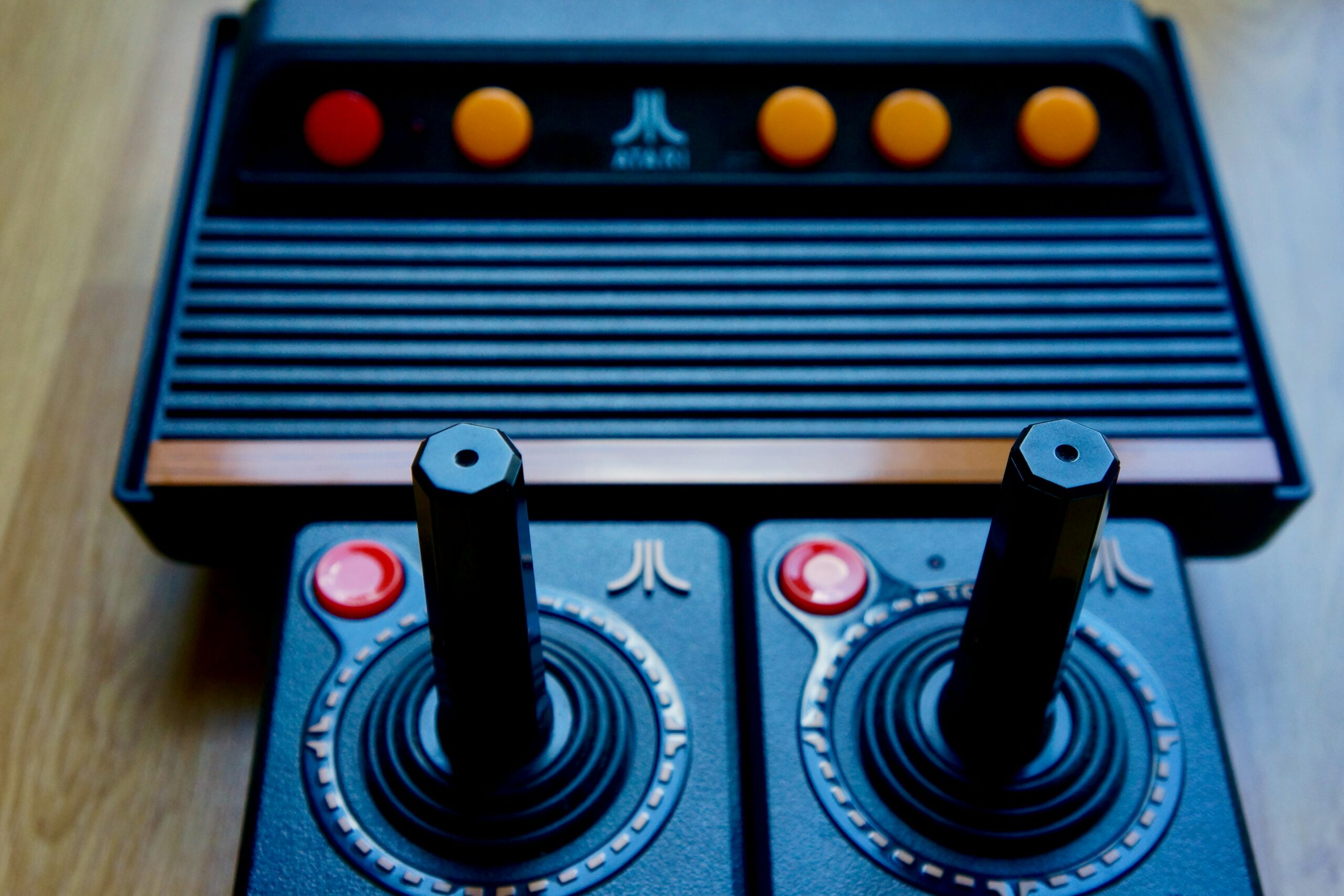
The history of Atari game consoles began with the Atari 2600, released in 1977. At a time when arcade games such as Space Invaders were among the top game titles, the Atari 2600 was the first game console to establish itself. After its release, the Atari 2600 became the game console of choice, with hit game titles such as Pong, Pac-Man, and Space Invaders gaining the console’s many fans. The Atari 2600 remained at the forefront of gaming into the early 1980s and was Atari’s best game console.
Atari 5200
The Atari 5200 was the sequel to the Atari 2600, released in 1982. However, the game console struggled to emulate the Atari 2600. As market conditions deteriorated in the early 1980s, the demise of the Atari 5200 was inevitable, and it was discontinued in 1984.
Atari 7800
The Atari 7800 continued the Atari game consoles in 1984 and would remain a good deal longer than its predecessor. That was due to its compatibility with the 2600 and perhaps also a revival in console gaming that followed the release of the NES game console. Although in truth, it could not emulate the Atari 2600, as the NES dominated during the remainder of the 1980s.
Atari XEGS
The XEGS was a hybrid 2-in-1 console and personal computer that Atari released in 1987. It was the last of Atari’s 8-bit computer line that came with a built-in Missile Command game. The basic Atari XEGS was more of a console that came with a CX40 joystick. Yet, the deluxe Atari XEGS had an attachable keyboard and XG-1 light gun.
In terms of industry impact, the XEGS was not among the foremost consoles of the 1980s. Although it sold quite well during its initial launch period, the console didn’t significantly challenge the NES or SEGA Master System beyond that. Yet, it was a cost-efficient console that Atari discontinued in 1991.
Lynx
The Atari Lynx was a color handheld game console released by Atari in the late ’80s. However, despite the Lynx having a superior color display compared with the Game Boy, good game titles were few and far between. In addition, the Lynx had short battery support. As such, the Lynx did not gain many fans.
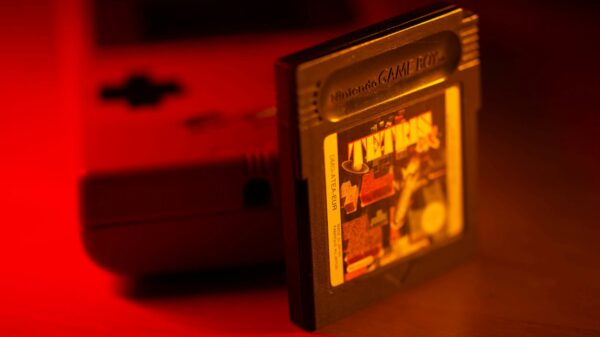
Things might have been different for the Lynx had Atari/Tengen secured handheld console rights for Tetris in 1989. Yet, Elorg granted handheld Tetris console rights to Nintendo in 1989. Then, Atari also lost a legal battle for Tetris rights. Consequently, Tetris became a killer game bundled with the Game Boy rather than the Lynx.
Jaguar
Atari claimed its Jaguar to be the first 64-bit game console in 1993 (it had two 32-bit processors but 64-bit graphics co-processors and a 64-bit data bus). That game console did have some notable game titles, such as Tempest 2000 and Alien vs Predator, which generated some enthusiasm for the Jag. However, its multiprocessing hardware was confusing for developers. Inadequate developer tools for the Jaguar also hindered the console. Consequently, third-party developer support for the Jaguar was limited, and many of the substandard games released for it looked little better than those available for 16-bit counterparts from a graphical perspective.
The result was a pretty big flop for Atari as the Jaguar struggled to compete with the 16-bit SNES and Mega Drive, let alone the next-gen Saturn and PlayStation. Estimates suggest the Jaguar shifted between 150,000 and 250,000 units, which was not nearly enough by the mid-1990s. Consequently, Atari discontinued the Jaguar in 1996, with the company in a pretty big financial mess. The Jaguar seemed to be the last of the Atari game consoles until more recent hardware forays.
Atari VCS
Atari launched a modern VCS (Video Console System) in 2021-2022, during its 50th anniversary year. The Atari VCS is a like a PC and console wrapped into one. It is a console based on a Atari OS Debian Linux variant that supposedly bridges the gap between PC and console gaming. Players can activate the PC Mode to play optional PC and Linux games. Its pre-installed Atari Vault app also enables players to play many classic games from the Atari arcade and console library.
If the VCS was an attempt to re-establish Atari as a serious brand in the gaming industry, it evidently failed. During 2022, Atari’s revenue dropped by 27 percent from the same period for the preceding year. Atari pulled the plug on the VCS toward the end of 2022 because it wasn’t shifting enough units. Thus, the VCS quickly became another Atari game console flop to add to its collection.
Atari Gamestation
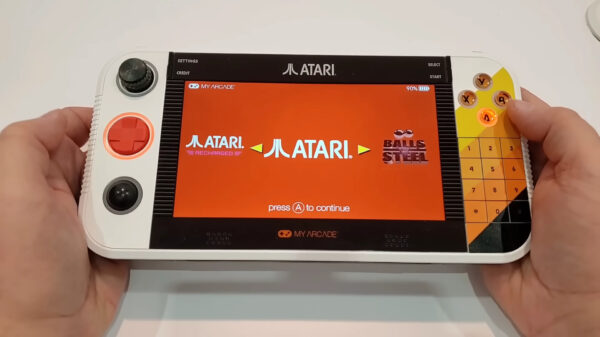
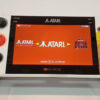
Yet, Atari still isn’t finished in the console industry despite the VCS flop. Atari launched the Gamestation Go in October 2025. Unlike the VCS, the Gamestation Go is entirely a retro-focused console on which you can play many Atari 2600, 5200, and 7800 games with more graphical gloss. It is a console you can play as a handheld or on TV, like the Nintendo Switch. The console has numerous controller options, such as a trackball, a D-pad, a number pad, and joysticks. Atari hopes to capitalize on an expanding retro gaming market with the Gamestation, but it’s unlikely this 2-in-1 handheld will become a serious alternative to the Switch 2 or Steam Deck.
So, the golden era for Atari came in the 1970s and early 1980s before the gaming industry crash. During the 1980s, the emergence of Nintendo and, to a lesser extent, SEGA, made reviving Atari game consoles harder. Atari could not reverse the decline with numerous other consoles launched thereafter. Surprisingly, Atari tried to re-establish a niche for itself in the console industry with the 2022 VCS, and the result of that hardware venture was predictable.














You must be logged in to post a comment Login