

































There’s a famous maxim often attributed to Winston Churchill: “History is written by the victors.” That notion seemed particularly relevant at the recent Morgan Stanley Media and Telecom Conference, where Jensen Huang, CEO of Nvidia, reflected on his company’s role in shaping the modern video game industry.
Nvidia, best known for its GeForce RTX graphics platform, designs computer chips, particularly GPUs, that have played a major role in advancing PC gaming and video games more broadly. For decades, the company’s graphics cards have pushed visual technology forward, enabling realistic lighting, complex 3D environments, and increasingly immersive game worlds.
Today Nvidia is known for far more than gaming. Its GPUs have become critical tools in several fast-growing sectors. Cryptocurrency mining helped drive demand for its hardware during the digital asset boom. More recently, the company has become central to the AI revolution, where its CUDA computing platform has become a key piece of infrastructure for large-scale machine learning.
That success has also been reflected in Nvidia’s stock performance. Over the past decade the company has delivered total returns of more than 20,000 percent, turning it into one of the most influential technology companies in the world.
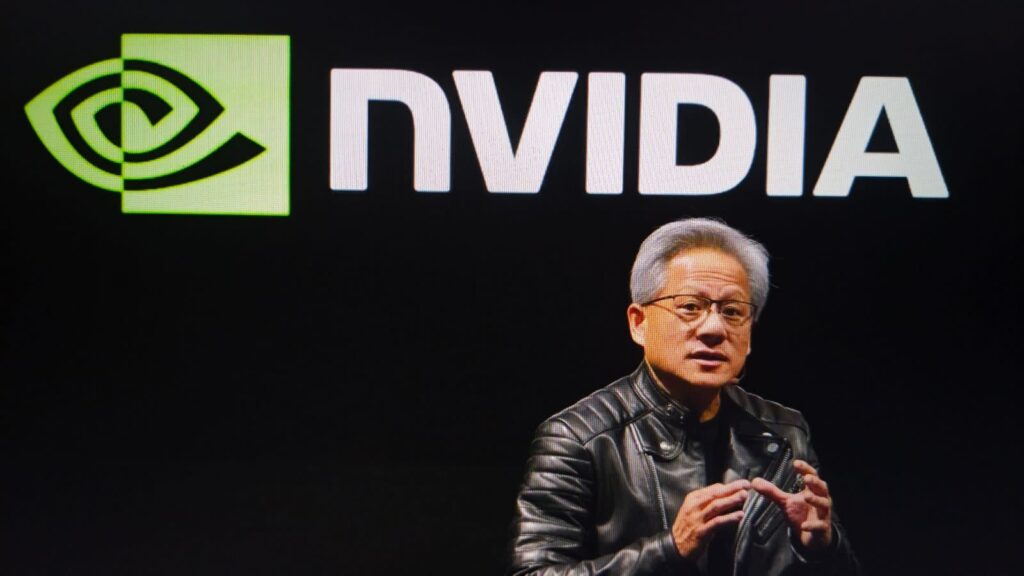
Nvidia CEO Jensen Huang
Despite Nvidia’s growing presence in AI and other industries, Huang emphasized that the company’s impact on gaming should not be overlooked.
“We started the company with the idea of creating a new computing platform, a new way of doing computing,” Huang said during the conference.
He explained that Nvidia’s early vision centered on algorithms and computational efficiency.
“The inner loop of software tends to be about 5 percent of the code but 99 percent of the compute time,” Huang said. “Back then algorithms in the world of computers were quite rare. One of the most important algorithms was computer graphics, the simulation of light and how light travels through space.”
When Nvidia was founded in the early 1990s, computer graphics technology was advancing rapidly. Graphics systems were becoming powerful enough to simulate immersive virtual environments.
“Computer graphics was used for things like animation movies,” Huang said. “But it was during that time where computer graphics was becoming more capable and we could simulate virtual reality with it. We applied it to creating a new industry, which did not exist at the time called video games.”
He continued:
“3D graphics was modernized in my time, consumerized in my time. And the whole video game industry was created in my time.”
Huang then made his most controversial claim, one that will likely spark debate among gamers and industry historians.
“It was Nvidia that pulled it all together,” he said. “The reason why we’re so beloved in the video game industry and we’re so deep in it still is, in a lot of ways, we created the modern video game industry.”
So, did Nvidia create modern gaming? Whether that claim holds up to scrutiny is open to debate. Still, Nvidia’s influence on gaming is undeniable. Do you agree or disagree with Jensen Huang’s comments on Nvidia’s modern gaming influence?









You must be logged in to post a comment Login