
























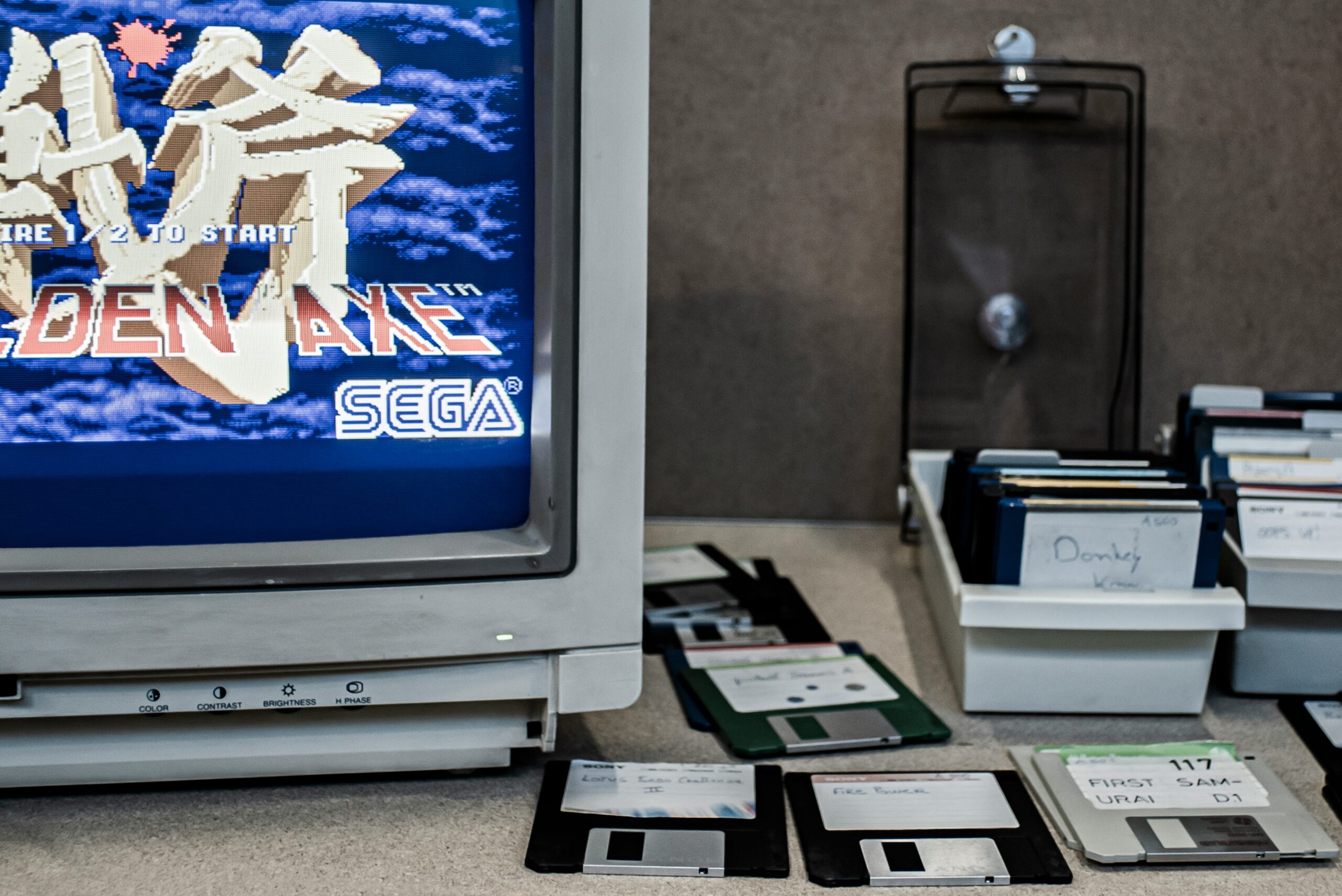
At the start of the 1990s, 3.5-inch floppy discs were the standard storage medium for PC video games. However, the widespread introduction of compact discs (CDs) changed PC and console gaming in the 1990s. The compact disc stored much more data than floppy discs. This is how CDs revolutionized video game graphics and audio as a new file storage medium during the 1990s.
Escaping the Floppy Bottleneck
The floppy disc could only store a meagre 1.44 megabytes of data. With developers rolling out more ambitious games in the early 1990s, storage limitations of floppy discs became increasingly apparent. Players needed to swap through many floppy discs to play games like King’s Quest VI.
However, CDs could store about 650 to 700 megabytes of data. Thus, compact discs offered a huge increase in storage for game developers to exploit. No longer did developers have to significantly compress textures, sprite art, or polygon data. CDs also streamlined game installation.
The Rise of Cinematic Storytelling and Full-Motion Video
Full-motion video was the biggest graphical revolution CDs ushered in. Compact discs enabled developers to release Hollywood-spectacle games with full-motion video. Developers released more and more games that blended gameplay with live-action footage.
Wing Commander III, Myst, and the 7th Guest were among the early CD-based games that showcased full-motion video. The Wing Commander III game was a space combat simulator that incorporated extensive live-action cutscenes with Hollywood actors. That game elevated the profile of cinematic video game acting.
Command & Conquer: Red Alert also further shaped cinematic game acting. Westwood integrated live actors into the real-time strategy game loop with direct-address cinematic cutscenes between missions. The C&C series embraced more Hollywood stars for games like Red Alert 2 and 3.
Redbook Audio and Orchestral Soundscapes
PC video games relied on synthesiser chips like the Roland MT-32 before CDs became mainstream. Floppy discs could not include large pre-recorded sound files. Audio quality in games depended heavily on sound cards.
The CD changed all that with Red Book audio, the same uncompressed digital sound standard for music CDs. This enabled developers to place live, pre-recorded orchestra and rock bands for video games directly onto discs. With pre-recorded CD audio, it was the same sound quality for everybody.
This sound revolution made a noticeable difference in games like Myst and 7th Guest, which had fully voiced narratives. Quake was a revolutionary first-person shooter with an atmospheric industrial musical score. The Tomb Raider video game also had more immersive CD audio mixed into its gameplay.
The Demo Disc Phenomenon
CDs established a new demo disc phenomenon at a time when there weren’t any notable digital storefronts. This established a new cultural wave of magazines giving away playable game previews via CDs. Magazines like PC Gamer affixed cover discs for gaming demo distribution.
Those cover discs became a cultural phenomenon for the entertainment value they offered. A single demo disc could pack in up to 10 playable demos. Smaller indie developers also gave away full video games via demo discs.
The CD Gaming Explosion
The considerable storage advantages of compact discs led to a CD gaming explosion for PC and consoles in the latter half of the 1990s. Groundbreaking video games like Half-Life fully exploited the optical disc format for more extensive scripted animations and voice acting. Although Half-Life wasn’t big on FMV, its real-time 3D graphics (based on a modified Quake engine) were quite revolutionary.
StarCraft was another amazing CD-based game that changed PC gaming. That game perfected the real-time genre with its balanced faction design, CD-quality audio, iconic unit voices, and pre-rendered CGI cutscenes. It established Battle.net and popularized esports.
Then there was Final Fantasy VII, which Square ported to PC. Square embraced CD-ROMs because cartridges lacked the storage space for its cinematic FF vision. This was a revolutionary RPG because it mixed real-time 3D polygons with CGI cutscenes. It also incorporated a sweeping orchestral soundtrack comparable to a blockbuster movie. Final Fantasy VII is among the best games in history because of its iconic soundtrack and cinematic storytelling.
The Decline of CDs
However, CDs eventually hit storage ceilings as 3D graphics evolved. Consequently, they became increasingly obsolete as DVD-ROMs emerged as higher storage alternatives. DVDs could hold up to 4.7 gigabytes of data for PC gaming. Yet, DVDs were an expansion of CDs as a higher-storage optical disc format.
The rise of Steam from 2004 also changed the PC gaming distribution landscape. Steam provided an alternative digital distribution platform to optical media. More and more developers added video games to Steam, which in turn led to a decline in DVDs. Today, many PCs do not include DVD drives because they are no longer essential for PC software distribution.
CD-ROMs’ legacy remains woven into PC gaming today. CDs laid the foundation for more cinematic games and video game acting. They blew away technical barriers by giving developers much more storage space for gaming experimentation.












You must be logged in to post a comment Login